 Dodoswap
Dodoswap slippage tolerance, price impact and minimum output
Dodoswap slippage describes the difference between the quoted swap rate and the final execution rate. Max Slippage sets the tolerated adverse movement, so a higher allowance can permit a worse exchange rate. A trade's own effect on pool pricing is price impact, which may already influence the quote. For a fixed-input route with minimum-output protection, the minimum received amount expresses the boundary in tokens. Wallet confirmation alone does not fix the final execution rate.
PMM inventory, routing and quoted output
DODO X selects trading routes by comparing DODO liquidity with external sources, while the pools along those routes supply liquidity and determine the prices available for the selected tokens and the specified input amount. A route can include intermediary tokens or divide the input across pools. These choices influence how much output the input can buy.
Within a Proactive Market Maker (PMM) pool, shrinking inventory raises the quoted price of the depleted asset. That adjustment encourages trades that replenish inventory. Other pools along an aggregated route can use different pricing mechanisms. A quoted output therefore reflects the selected amount and available route; it does not establish the output for a different trade size.
Quote movement before execution
A displayed quote describes an exchange under the conditions used to calculate it. Those conditions can change before a transaction executes, even when the selected tokens and input amount remain unchanged.
Changes in pool inventory
Other trades can change the liquidity available along a route. A refreshed quote may consequently show a different output for the same input. This movement differs from changing the input yourself, which asks the routing system to price a different trade against available liquidity.
Time awaiting confirmation
A pending swap faces the pool conditions available when its contract executes. Time spent waiting for blockchain confirmation leaves room for those conditions to move. Low gas pricing can delay confirmation. The configured transaction deadline separately limits how long the swap remains eligible for execution.
Minimum received and output-based arithmetic
Minimum received names the lower output boundary for a fixed-input swap. In the documented DODOFeeRouteProxy implementation, the swap reverts if its checked output falls below the submitted minimum return amount. DODOFeeRouteProxy's fee-routing implementation checks the amount left after route and broker fee deductions. The floor is an execution constraint, not a prediction that the swap will return exactly that quantity. Its scope belongs to the particular route and transaction.
For an output-based allowance, let Q represent quoted output, t represent tolerance as a decimal fraction and M represent minimum output. The percentage-reduction relationship is M = Q × (1 - t), before token-unit rounding. The adverse shortfall between quoted output Q and actual output A is (Q - A) / Q × 100%. Both quantities must refer to the same output token and fixed input, with fees handled on the same basis. These relationships explain percentage allowances; the transaction's submitted minimum remains the operative floor.
The output boundary through a same-chain swap
A fixed-input swap that returns less than its quote can still satisfy its minimum-output constraint. The quote describes expected output; the transaction carries the enforceable floor. If execution produces at least that floor before the deadline, the price boundary permits the exchange while other transaction checks still apply.
| Swap stage | Protection or execution constraint |
|---|---|
| Select tokens and input | The token identities and input amount define the quote's scope. |
| Configure trade settings | Tolerance and the deadline limit permitted execution terms. |
| Authorize and confirm | Token approval permits spending; wallet confirmation authorizes the swap. |
| Execute on-chain | The route must satisfy its checked minimum output and deadline. |
Dynamic, Custom and Private Swap controls
DODO's Swap settings include Dynamic and Custom options for Max Slippage. Private Swap addresses a separate source of execution risk.
Dynamic suggestions
Dynamic uses suggested values based on historical transaction data. Those suggestions do not lock present liquidity or guarantee the final rate. The resulting allowance still governs acceptable movement for the selected trade, so the current quote and minimum output remain relevant.
Custom tolerance
Custom lets the trader choose the allowance. Increasing it can let a swap proceed through a larger adverse change, with a lower acceptable output. In DODO's Swap interface, a reported pre-trade token-price deviation above 20% requires Expert Mode before submission. That threshold concerns permission to submit a trade with that reported price deviation; it is not a recommended tolerance.
Private Swap protection
Private Swap targets sandwich attacks, which can exploit the room between permitted slippage and pool pricing. A wider allowance can leave more room for adverse execution. Where the feature is available, its protection addresses that attack mechanism. It does not make a quoted rate immune to ordinary liquidity changes.
Slippage failures and separate execution limits
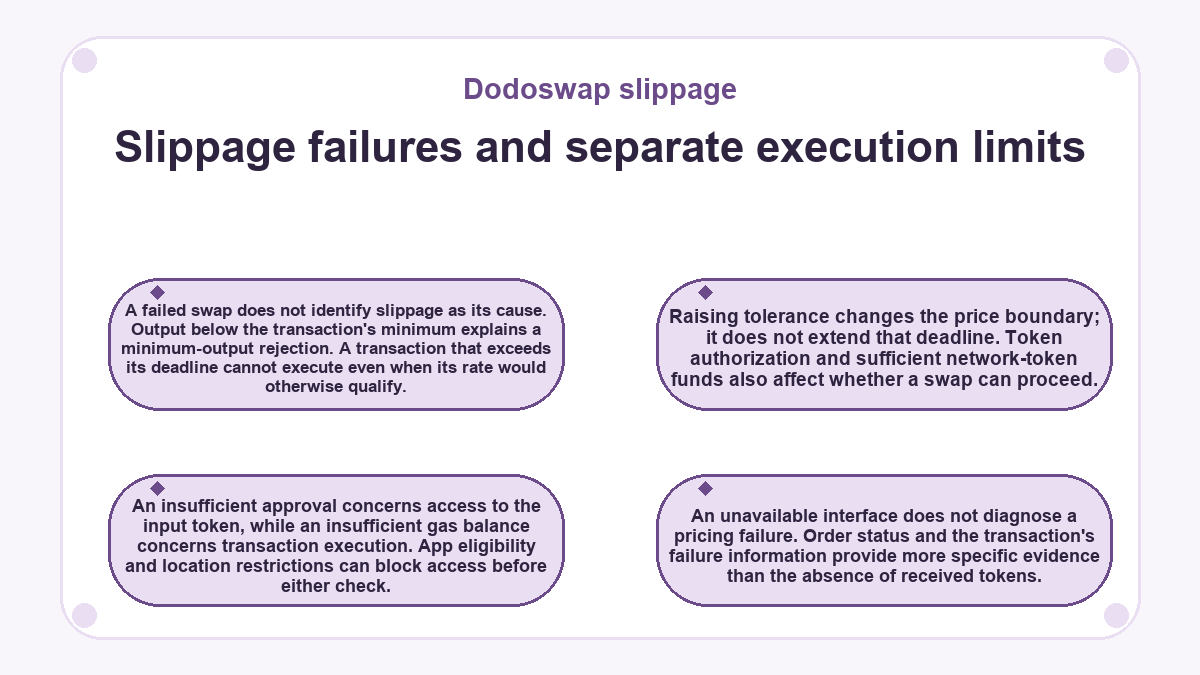
A failed swap does not identify slippage as its cause. Output below the transaction's minimum explains a minimum-output rejection. A transaction that exceeds its deadline cannot execute even when its rate would otherwise qualify. Raising tolerance changes the price boundary; it does not extend that deadline.
Token authorization and sufficient network-token funds also affect whether a swap can proceed. An insufficient approval concerns access to the input token, while an insufficient gas balance concerns transaction execution. App eligibility and location restrictions can block access before either check. An unavailable interface does not diagnose a pricing failure. Order status and the transaction's failure information provide more specific evidence than the absence of received tokens.
Price impact already inside the quote
Price impact describes how the selected trade affects pool pricing. A large input relative to available liquidity can produce an unfavorable quote before the transaction enters the blockchain. A pre-trade warning concerns displayed price deviations; realized slippage requires an executed rate. Lowering tolerance constrains subsequent adverse movement; it does not improve that starting quote.
Changing the input asks the pools to price a different quantity. Compare output per unit of input when assessing those quotes, since a smaller trade naturally returns fewer total tokens. Liquidity depth and the chosen route determine whether the unit rate improves.
Disabling indirect routing restricts the search to pools between the selected tokens and removes intermediary-token paths. That restriction can exclude routes that would otherwise supply liquidity. A limit order uses a chosen price condition, while Swap mode uses an available quote with execution constraints. If the quote itself is unacceptable, widening tolerance expands the range of worse rates that the swap may accept.
Helpful answers about Dodoswap slippage
Does changing Dodoswap slippage tolerance also change my token approval?
Slippage tolerance and token approval govern different permissions. Tolerance limits acceptable price movement during the swap; approval lets a contract access the input token within the wallet's allowance. Changing a price setting does not itself enlarge that allowance. A successful approval also does not establish that the swap has completed.
Is the slippage allowance an additional Dodoswap trading fee?
The slippage allowance is a permitted execution deviation, not a fee that Dodoswap automatically deducts. Routing fees, pool fees and network gas have separate mechanisms. A worse executed rate can reduce received tokens without creating an additional fee equal to the tolerance percentage.
Can a swap that fails its slippage check still consume gas?
An Ethereum swap that reaches on-chain execution can consume gas even when a slippage check makes it revert. The network charges for computation, including failed execution. A rejected wallet request or a trade that never reaches the blockchain is a different state.
Should liquidity-deposit Auto values determine my swap tolerance?
Liquidity-deposit Auto settings govern adding funds to a pool, while Swap Dynamic settings govern a token exchange. The deposit interface adjusts its Auto allowance using the trading pair's liquidity classification. Swap Dynamic uses historical transaction data. These controls cover different operations, so a deposit percentage does not establish the appropriate boundary for a swap.
How do cross-chain routes change the scope of minimum-output protection?
A same-chain minimum-output floor applies to the swap that enforces it. DODO X aggregates multiple bridge products for cross-chain trading. The quoted destination amount belongs to the selected route and its execution conditions. An amount checked by one swap contract does not automatically describe every bridge operation or guarantee the final destination balance.
Could delayed market-price updates trigger a Dodoswap slippage warning?
A delayed market-price update can contribute to a high-slippage warning in DODO's Swap interface. The interface can flag a price deviation before a swap executes. Low liquidity can cause a warning as well. The alert concerns displayed pricing; the actual execution rate establishes realized slippage after a completed swap.
Will a higher Max Slippage setting change the PMM price curve?
Max Slippage changes the trade's permitted deviation, while the PMM curve's k parameter governs sensitivity to pool inventory. A larger k makes the curve steeper and increases inventory-related price sensitivity. Changing the trader's tolerance does not reconfigure that pool parameter or add liquidity, so it cannot repair an unfavorable underlying quote.