 Dodoswap
 combines PMM liquidity pools with DODO X swap routing
Dodoswap combines DODO liquidity pools and DODO X aggregation for decentralized token swaps across supported networks. Its Proactive Market Maker (PMM) algorithm adjusts pool prices as token inventories change. DODO X searches those pools, external exchanges and other aggregators for quotes, including routes between chains. The wider ecosystem also supports liquidity provision, token creation and fundraising. Pool generation, route availability and app access conditions determine which functions apply to a particular task.
DODO pools and the DODO X routing layer
DODO pools supply liquidity that traders can exchange, while DODO X searches across sources to find trading routes. Each pool's inventory and pricing mechanism shape the quote that it can offer. The routing layer compares opportunities across pools and aggregators, so a swap does not necessarily use DODO liquidity throughout.
External sources include Uniswap, Curve and PancakeSwap, with additional quotes from aggregators such as 1inch and 0x. These integrations expand the search beyond a single pool family. Each source has its own pricing mechanism; aggregation does not turn external pools into PMM pools.
DODO X also provides a trading API and widget, allowing applications to incorporate its routing functions into their own interfaces. DODO limit orders let traders set a price condition and trade amount. The app trading tutorial specifies a minimum order value of $2,000 for Limit mode to cover execution costs.
The wider ecosystem includes the DODO token and the vDODO membership token, alongside trading and liquidity services. Their governance and membership roles differ from the pricing work performed by pools. DODO Research publishes material about the ecosystem and broader crypto topics, separately from trade execution.
How does PMM respond to changing inventory?
PMM increases the quoted price of an asset when that asset becomes scarcer within the pool's inventory. The adjustment encourages trades that replenish depleted inventory. DODO's Ethereum Virtual Machine (EVM) implementation uses smart-contract liquidity without placing conventional buy and sell orders.
The parameter k controls how strongly the price curve responds to changes in inventory. A higher k produces a steeper curve and greater sensitivity. A lower k flattens the curve and concentrates more liquidity around the reference price. This pool parameter differs from slippage tolerance, which limits acceptable changes in a trader's execution price. Concentrating liquidity does not remove exposure to changing market prices.
Pool generations and the routing layer
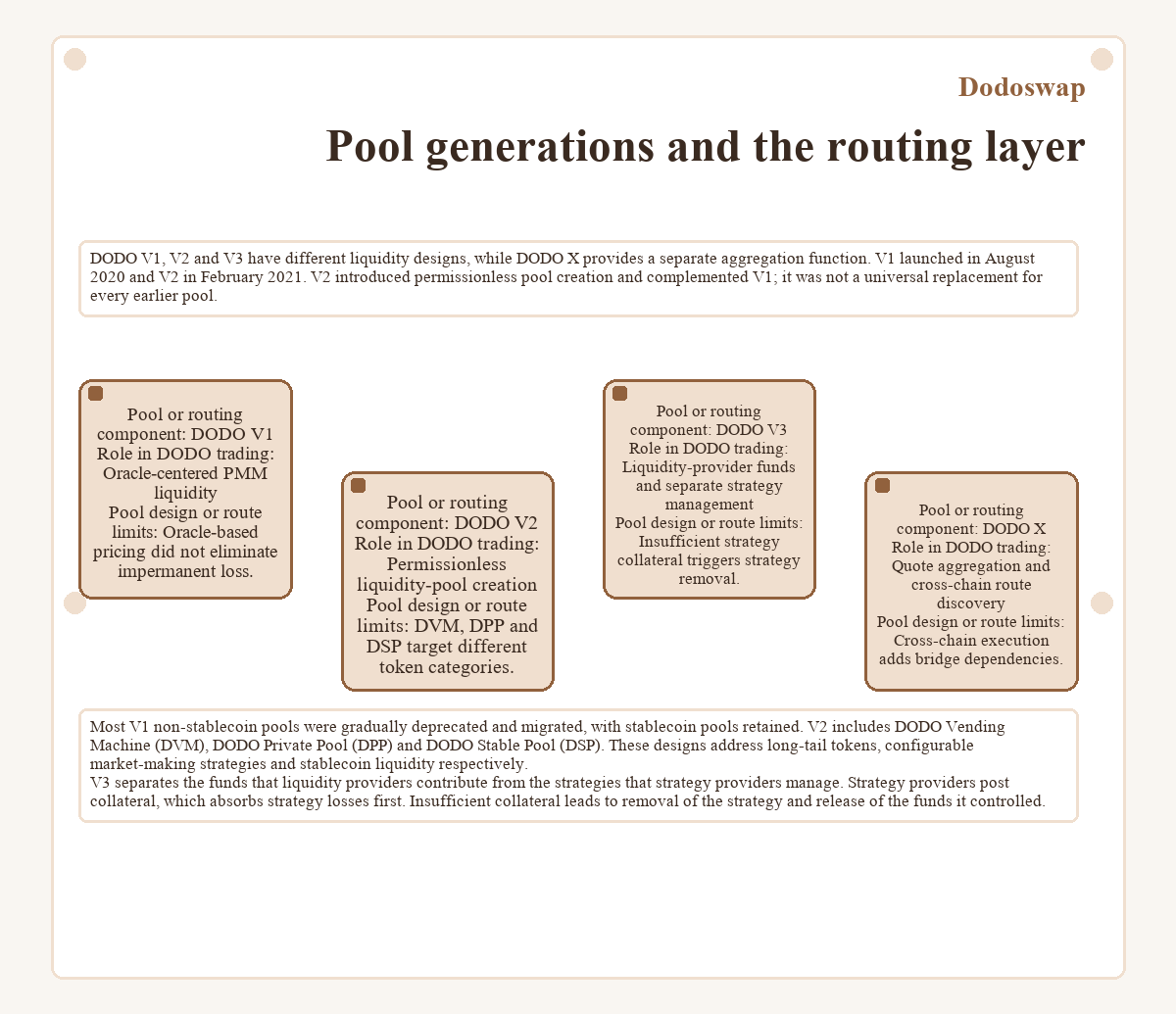
DODO V1, V2 and V3 have different liquidity designs, while DODO X provides a separate aggregation function. V1 launched in August 2020 and V2 in February 2021. V2 introduced permissionless pool creation and complemented V1; it was not a universal replacement for every earlier pool.
| Pool or routing component | Role in DODO trading | Pool design or route limits |
|---|---|---|
| DODO V1 | Oracle-centered PMM liquidity | Oracle-based pricing did not eliminate impermanent loss. |
| DODO V2 | Permissionless liquidity-pool creation | DVM, DPP and DSP target different token categories. |
| DODO V3 | Liquidity-provider funds and separate strategy management | Insufficient strategy collateral triggers strategy removal. |
| DODO X | Quote aggregation and cross-chain route discovery | Cross-chain execution adds bridge dependencies. |
Most V1 non-stablecoin pools were gradually deprecated and migrated, with stablecoin pools retained. V2 includes DODO Vending Machine (DVM), DODO Private Pool (DPP) and DODO Stable Pool (DSP). These designs address long-tail tokens, configurable market-making strategies and stablecoin liquidity respectively.
V3 separates the funds that liquidity providers contribute from the strategies that strategy providers manage. Strategy providers post collateral, which absorbs strategy losses first. Insufficient collateral leads to removal of the strategy and release of the funds it controlled.
Pool generations and the routing layer
- Pool or routing component: DODO V1 Role in DODO trading: Oracle-centered PMM liquidity Pool design or route limits: Oracle-based pricing did not eliminate impermanent loss.
- Pool or routing component: DODO V2 Role in DODO trading: Permissionless liquidity-pool creation Pool design or route limits: DVM, DPP and DSP target different token categories.
- Pool or routing component: DODO V3 Role in DODO trading: Liquidity-provider funds and separate strategy management Pool design or route limits: Insufficient strategy collateral triggers strategy removal.
- Pool or routing component: DODO X Role in DODO trading: Quote aggregation and cross-chain route discovery Pool design or route limits: Cross-chain execution adds bridge dependencies.
Can DODO X swap tokens across chains?
DODO X supports swaps between different blockchains when an available route connects the selected networks and tokens. A cross-chain route has dependencies beyond the price that a liquidity pool quotes. It combines liquidity access with the bridge mechanism that transfers value between networks, so the starting chain and destination chain both matter.
DODO X aggregates multiple cross-chain bridges when searching for cross-chain trading routes. Its liquidity-source coverage includes Ethereum, Arbitrum One and Base, with different integrations on each network. Available token combinations depend on connected pools and bridges. Processing time and bridge charges depend on the selected route.
Token creation and liquidity campaigns
DODO Toolbox connects token creation, initial distribution and liquidity incentives, giving the ecosystem functions beyond exchanging assets that already have markets.
ERC-20 token creation
The token-creation tool supports ERC-20 contracts on EVM-compatible blockchains. Issuing a token and creating a pool that trades it are separate functions.
Supply and token metadata
The creation interface accepts a token name, total supply and decimal setting. Those fields define basic issuance and unit display; they do not establish market demand or pool liquidity.
Optional token behavior
Optional features include token burning, trading fees and supply increases. A token-level trading fee is separate from the fee that a swap route charges. These settings govern token behavior; the PMM curve governs pool pricing.
Crowdpooling and liquidity mining
Crowdpooling combines fundraising and token distribution with the formation of a liquid market. Its liquidity protection period temporarily prevents withdrawals by the project initiator from the resulting pool. Liquidity mining rewards participation in a campaign; DODO Toolbox includes single-token staking and liquidity-provider (LP) market-making campaigns. The latter involves liquidity-pool exposure, so campaign rewards do not remove the risks of the deposited assets.
What determines the cost of a swap?
Swap cost combines the fee that a liquidity source charges with applicable routing or bridge charges and network gas. The liquidity-provider fee varies by pool, and the pool details identify its rate. A quoted exchange rate describes token conversion, while gas pays for the network resources that execute the transaction.
Routing charges depend on the algorithm and interface, with additional fees possible in an embedded DODO widget. Cross-chain routes also involve bridge-dependent charges. Slippage tolerance controls acceptable execution-price changes; it is separate from the pool fee and gas cost. A larger tolerance does not reduce either charge and can permit a worse execution price.
Wallet control and app access
DODO does not retain a user's wallet private keys. Token approvals authorize a contract to spend a specified token allowance, so its amount matters. Approval alone does not execute a swap. Liquidity deposits place assets under the rules of the selected pool contract, even though the wallet remains under the user's control.
App access has eligibility and geographic restrictions, separate from the public availability of smart contracts. The DODO app excludes users located in, established in or resident of the United States (including its territories), China or another prohibited locality. Users must be at least 18, or the local age of majority if higher. Sanctions restrictions also apply, and the app prohibits using a VPN to circumvent access restrictions.
Contract audits concern particular versions and codebases. DODO publishes separate audit records for V1, V2 and other components. An audit of one contract does not cover every external pool or bridge within an aggregated route.
Popular questions about Dodoswap
Can a DODO V1 pool accept liquidity in a single asset?
DODO V1 supports single-sided deposits and withdrawals, allowing liquidity providers to contribute one asset. Deposit requirements vary across other pools, so single-sided support cannot be assumed from the DODO name alone.
When can withdrawing V1 liquidity incur an extra fee?
A DODO V1 withdrawal can incur an additional fee when it removes an asset that is already scarce in the pool. The withdrawal increases inventory imbalance, and the fee compensates providers who remain in the pool. This inventory-based rule applies to V1; it is separate from the network gas charge that processes the withdrawal.
Does a DODO limit order remain active indefinitely?
A DODO limit order expires at the expiration time set for that order. Its specified price condition must be met while the order remains active, and meeting that condition alone does not assure execution. Submission and execution are separate states. An unfilled order that reaches expiry does not become a completed swap.
How does an oversubscribed Crowdpooling campaign allocate contributions?
An oversubscribed DODO Crowdpooling campaign allocates participation in proportion to contributions and refunds excess funds. The campaign specifies the contribution token and the Crowdpooling price. The final token purchase uses only the allocated contribution.
Do liquidity-mining rewards represent the same income as pool trading fees?
Liquidity-mining rewards and pool trading fees arise from different activities. Pool fees come from swaps that use the pool, while mining rewards follow a campaign's incentive program. A campaign's reward rate therefore does not describe the fee rate that a pool charges traders.
Who receives an additional fee set by a DODO widget integration?
The application or integrator that sets an additional widget routing fee receives that additional fee. DODO does not take a share of this application-set charge. It is separate from liquidity-provider charges and any routing fee within the widget's own schedule, so the extra fee does not describe the entire cost of a swap.
Are DODO and vDODO interchangeable tokens?
DODO and vDODO are separate tokens with different functions. DODO has governance and ecosystem-incentive roles, while vDODO represents membership and associated reward rights. The membership mechanism mints one vDODO for 100 pledged DODO tokens. That relationship is a token-conversion rule; it does not describe a liquidity-pool deposit ratio or a swap price.